I spent three hours last Saturday on a ridge in the Cascades, cursing a piece of RG-58 that I’d foolishly dragged along because it was “lightweight.” I was sitting there, staring at a near-perfect SWR on my meter, wondering why my signal was hitting the floor instead of the DX stations I knew were open. That’s the frustrating reality of amateur radio: you can build the most efficient dipole in the world, but if you don’t understand what is feedline loss, you’re essentially just paying to heat up your coaxial cable. Most of the marketing fluff tells you that a little attenuation is “negligible,” but when you’re running a low-power portable rig, negligible is a lie.
I’m not here to give you a theoretical lecture from a textbook that hasn’t been updated since the Reagan administration. Instead, I’m going to show you the actual math and the real-world consequences of your cable choices. We’ll look at how different frequencies change the game, why your cable length matters as much as the dielectric, and exactly where you should spend your money and where you can afford to be cheap. No hype, just the numbers.
Table of Contents
The Brutal Truth About Coaxial Cable Attenuation
Here is the reality: not all coax is created equal, and your choice of cable is often the difference between a clear contact and shouting into a void. When we talk about coaxial cable attenuation, we aren’t just talking about a theoretical number in a manufacturer’s datasheet. We’re talking about how much of your precious RF signal power loss is happening inside that jacket before it ever reaches your antenna. If you’re running fifty feet of cheap, thin RG-58 up to a VHF dipole, you might as well be throwing half your power into the dirt.
I’ve seen too many operators blame their transceiver’s receiver sensitivity when the real culprit is signal degradation in transmission lines. As the frequency climbs, the physics gets unforgiving. Higher frequencies simply don’t like traveling through lossy dielectrics. You might think a little extra loss is negligible, but in the world of decibels, it adds up fast. If you aren’t accounting for your transmission line efficiency, you’re essentially flying blind. Don’t let a poorly chosen cable be the bottleneck in your station.
Measuring Real Rf Signal Power Loss in the Line
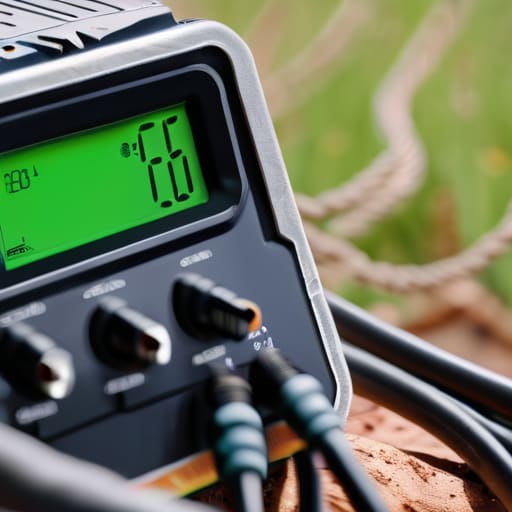
You can look at a spec sheet all day, but those numbers are measured in a climate-controlled lab with cables that haven’t seen a single bend or a drop of rain. In the real world, you need to actually see the RF signal power loss for yourself. If you have a decent wattmeter, use it. I always do a “before and after” test: measure the power coming straight out of the rig, then swap in your long run of coax and measure again at the antenna terminal. That delta is your reality.
Don’t get tripped up by the math alone, either. A simple decibel loss calculation might tell you that you’re losing 1.5 dB, but that doesn’t account for the mess you’ve made with tight bends or cheap connectors. If your SWR is jumping around, you aren’t just dealing with attenuation; you’re likely fighting impedance mismatch effects that are turning your precious signal into heat. If the numbers don’t line up with the manufacturer’s datasheet, trust your meter, not the glossy brochure.
Five Ways to Stop Throwing Your Watts in the Trash
- Stop treating your coax like it’s universal. If you’re running a 100W rig on 10 meters using a thin, cheap RG-58 run that’s longer than twenty feet, you aren’t actually transmitting 100 watts; you’re running a very expensive space heater in your shack. Match your cable diameter to your frequency.
- Watch your bends like a hawk. I’ve seen too many people kink their coax or pull it around a sharp corner of a metal equipment rack, thinking “it still looks fine.” You’re changing the geometry of the dielectric and creating a localized impedance mismatch that eats your signal. Keep your curves gradual.
- Connectors are where the magic—and the misery—happens. A poorly crimped connector or a cheap PL-259 with a loose center pin can introduce more loss than fifty feet of decent cable. If you aren’t using a torque wrench or at least being meticulous about your soldering, you’re just adding resistance to the equation.
- Check your SWR, but don’t get obsessed with the number alone. A low SWR at the rig doesn’t mean your antenna is efficient; it just means the rig isn’t seeing a mismatch. If your feedline is failing, you might see a “good” SWR at the radio, but your actual radiated power will be pathetic because the energy is being lost in the line before it ever reaches the radiator.
- Remember that temperature and moisture aren’t just “weather factors”—they are electrical variables. I’ve measured significant increases in attenuation on outdoor runs when the humidity spikes or when a cable gets baked in direct summer sun. If you’re building a permanent station, use UV-rated, outdoor-grade jacketed cable, or prepare to re-run the line in two years.
The Bottom Line on Your Feedline
Stop guessing with the math in a textbook; if you haven’t measured the actual loss with a tracker or a wattmeter, you don’t actually know how much power is reaching your antenna.
Your cable choice isn’t just about cost—if you’re running thin, cheap coax up a tall mast for VHF or UHF, you’re effectively turning your expensive radio into a very inefficient space heater.
Remember that loss isn’t a constant; it scales with frequency, so a cable that works fine for 40 meters might be practically useless when you try to move up to 10 meters.
The Real Cost of Cheap Coax
You can buy the most expensive, high-end transceiver on the market, but if you’re feeding it through fifty feet of low-grade RG-58 to reach a dipole at six meters, you aren’t operating a radio—you’re just powering a very expensive heater in your backyard.
Wren Castellano
Stop Guessing and Start Measuring
At the end of the day, feedline loss isn’t some theoretical concept from a textbook; it’s the physical reality of your signal fighting its way through copper and dielectric. We’ve looked at how frequency climbs, how cable length drags you down, and why your choice of coax can make or break a DX attempt. If you’re running a thin, cheap RG-58 up a twenty-foot mast for 10-meter work, you aren’t just losing signal—you’re throwing money into the dirt. Don’t fall into the trap of thinking a higher-wattage transceiver will compensate for a bad line. You can’t out-power physics, and you certainly can’t out-shout a bad connection once that energy has already bled off into heat inside your cable jacket.
I know it’s tempting to just plug everything in and hope for a miracle when the band opens, but there is a specific kind of satisfaction in knowing exactly what your system is capable of. When you finally hear that distant station through the noise, and you know it’s because your feedline is efficient and your antenna is at the right height, it feels different. It’s not luck; it’s engineering. So, grab your wattmeter, check your cables, and respect the physics of your station. Once you stop guessing and start measuring, you stop being a passenger in your own hobby and start actually controlling the airwaves.
Frequently Asked Questions
If I switch from RG-58 to something thicker like LMR-400, am I actually going to notice a difference on the 20m band, or is it just extra weight in my pack?
If you’re running a short run from a rig to a desk, you won’t see much. But if that coax is stretching 50 feet up a tree to a dipole on 20m, the difference is massive. I’ve measured the drop; switching from RG-58 to LMR-400 on a decent run can reclaim nearly a full SWR-corrected decibel. That’s the difference between a weak signal and a solid contact. If you’re portable, it’s heavy, but it’s not just dead weight.
Does a high SWR in my line actually increase the loss, or am I just losing power to heat in the transmitter?
It’s both, and that’s where people get tripped up. If you have a high SWR, you’re losing power in two distinct ways. First, you’re losing energy to heat inside the transmitter’s final stage because the reflected power is pushing back against the circuitry. Second, that mismatch can actually change how the cable behaves, potentially increasing attenuation. You aren’t just losing signal to the air; you’re literally cooking your rig and wasting juice in the coax.
How much does the length of my cable really matter if I'm only running a low-power QRP setup?
It matters more than you think. When you’re running 5 watts, a 3 dB loss isn’t just a minor annoyance—it’s literally cutting your output power in half. If you’re using fifty feet of cheap RG-58 to get up to a tree, you might be throwing away two watts before the signal even sees the antenna. In QRP, your margin for error is razor-thin. Don’t let a long, mediocre cable turn your precious 5 watts into a pathetic 2.
