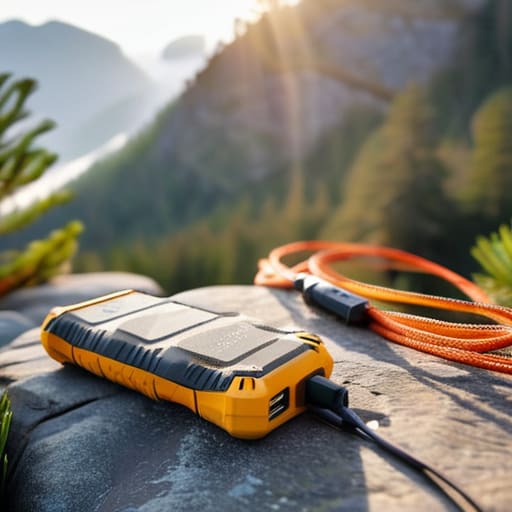
I was three miles up a ridge in the Catskills last October, staring at my transceiver’s dying display, when I realized my “high-capacity” brick was nothing more than a glorified paperweight. I had spent forty minutes calculating my link budget, only to be undone because I trusted a shiny sticker instead of a load test. Most people approach learning how to pick a portable power bank by reading the marketing fluff on the box, but if you’re running sensitive RF gear or even just a modern smartphone, those mAh ratings are often total fiction. They tell you what the cells can hold in a vacuum, not what they can actually deliver when the voltage starts to sag under a real load.
I’m not here to sell you on a specific brand or repeat the same tired specs you’ve seen on every retail site. Instead, I’m going to show you how to look past the glossy packaging and focus on the metrics that actually matter: voltage stability, discharge rates, and real-world efficiency. I’ve put these units through the ringer with my own test gear, and I’ll tell you exactly which ones hold their line and which ones are just expensive junk waiting to fail you when you’re off the grid.
Table of Contents
- Mah vs Wh Explained Why Marketing Numbers Are Often Lies
- Lithium Ion vs Lifepo4 Comparison Measuring Real Battery Cycle Life
- Stop Guessing and Start Measuring: 5 Rules for Real-World Power
- The Bottom Line Before You Pack Your Bag
- The Voltage Trap
- Stop Guessing and Start Measuring
- Frequently Asked Questions
Mah vs Wh Explained Why Marketing Numbers Are Often Lies

If you’re looking at the back of a box and only seeing a massive number followed by “mAh,” you’re being sold a half-truth. Manufacturers love milliamp-hours because it’s a big, shiny number that looks impressive on a retail shelf, but it’s a mathematically incomplete metric. The problem is that mAh doesn’t tell you anything about the energy density or the voltage at which that capacity is being delivered.
To actually understand what you’re carrying in your pack, you need to look at the Wh (Watt-hours). This is where the real math happens. A 10,000mAh battery at 3.7V is a very different beast than a 10,000mAh battery at a higher voltage. When I’m planning a weekend of portable operating, I don’t care about the milliamp count; I care about the total energy budget. If you’re trying to calculate how many hours your SDR or transceiver will run before the lights go out, stop looking at the mAh and start calculating the Wh. It’s the only way to get a realistic sense of your runtime versus the portable battery weight and size you’re forced to lug up a ridge.
Lithium Ion vs Lifepo4 Comparison Measuring Real Battery Cycle Life
Most manufacturers will push Lithium-ion (Li-ion) because it’s light and cheap to mass-produce, which is great if you’re just charging a phone on a train. But when I’m packing for a weekend on a ridge, I look at the chemistry differently. Li-ion cells are fine, but they’re temperamental; they don’t like being drained to zero, and they definitely don’t like heat. If you’re looking for a long-term investment, a lithium ion vs lifepo4 comparison shows a massive gap in longevity. I’ve seen Li-ion packs start to lose their “oomph” after maybe 300 to 500 cycles, whereas LiFePO4 cells can often push past 2,000 cycles without breaking a sweat.
The trade-off is almost always portable battery weight and size. LiFePO4 is significantly heavier and bulkier for the same amount of energy stored. If you’re hiking five miles to a summit, that extra pound in your pack matters. However, if your goal is a stationary setup or something that sits in your kit for years, the battery cycle life of LiFePO4 makes it the clear winner. I choose my chemistry based on the mission: Li-ion for the lightweight sprint, LiFePO4 for the long haul.
Stop Guessing and Start Measuring: 5 Rules for Real-World Power
- Look at the discharge curve, not just the capacity. A power bank might claim 20,000mAh, but if the voltage sag is aggressive once you hit a 2A load—like when your SDR or handheld rig starts pulling peak current—that capacity is useless. I’ve seen banks that look great on paper but drop below usable voltage the second you actually try to do work with them.
- Check the actual output voltage stability. If you’re powering sensitive radio gear or a laptop, you don’t want a unit that fluctuates wildly every time the internal regulator struggles. I always check if the output stays within a tight tolerance; if the manufacturer won’t list the ripple or voltage regulation specs, they’re likely hiding a cheap, noisy circuit.
- Factor in the conversion tax. You aren’t getting 100% of that rated capacity into your device. Between the heat loss in the boost converter and the inherent inefficiency of moving energy from 3.7V internal cells up to 5V or 12V, you’re realistically looking at about 65-75% efficiency. If you need 40Wh of actual energy for a long weekend on a hill, don’t buy a 40Wh bank; buy a 60Wh one.
- Prioritize port versatility over “fast charging” buzzwords. I don’t care if it claims to charge a phone in twenty minutes if it doesn’t have a stable USB-C PD (Power Delivery) output that can negotiate the correct voltage for your specific gear. Make sure it has enough high-draw ports to handle your primary device and your backup without the whole unit overheating and thermal-throttling into oblivion.
- Weigh the trade-off between density and durability. High-density lithium-polymer packs are great for keeping your pack weight down on a hike, but they’re finicky. If you’re roughing it in the field, a slightly heavier LiFePO4-based unit or a more robustly encased cell is worth the extra grams because it won’t quit on you just because the temperature dropped ten degrees or you bumped it against a rock.
The Bottom Line Before You Pack Your Bag
Stop obsessing over the mAh rating on the sticker; look at the Watt-hours (Wh) instead, because that’s the only number that actually tells you how much work your radio can do before the voltage sags and your rig shuts down.
If you’re planning a multi-day trek, prioritize LiFePO4 cells even if they’re heavier; I’ve measured the discharge curves, and they hold a steady voltage long after standard Lithium-Ion packs start dropping off and leaving you with nothing but a dead transceiver.
Always budget for a 20% loss in capacity due to heat and conversion inefficiency—if your math says a pack will run your rig for five hours, expect four, especially if you’re operating in the sun or using a high-draw SDR.
The Voltage Trap
Stop obsessing over the mAh printed on the side of the casing; that number is a marketing abstraction that assumes a perfect world. If you’re out on a ridge trying to keep a transceiver alive, you need to look at the Wh and the actual voltage sag under load. I’ve seen plenty of “high-capacity” bricks that look great on paper but drop their voltage the second you hit the PTT, leaving you with nothing but a dead radio and a long walk back down the hill.
Wren Castellano
Stop Guessing and Start Measuring
At the end of the day, picking a power bank for your field kit isn’t about finding the biggest number on the sticker; it’s about finding the one that actually holds its line when the load gets heavy. I’ve learned the hard way that a high mAh rating means nothing if the voltage sag kills your SDR or prevents your transceiver from hitting its rated output. You need to look past the marketing fluff and prioritize real-world Wh ratings and chemistry that can handle the cycles. Whether you go with the high energy density of Lithium Ion or the rugged longevity of LiFePO4, make sure you’re testing for actual capacity under load before you trust that battery to be your lifeline on a remote ridge.
Radio is about being prepared for the variables we can’t control—the shifting ionosphere, the sudden rain squall, or the terrain that eats your signal. Your power source shouldn’t be another variable you’re sweating over. When you build a kit based on measurements rather than hearsay, you gain something more valuable than just extra runtime: you gain predictability. There is a quiet, immense satisfaction in sitting out on a hill, knowing exactly how many hours of operation you have left because you did the math beforehand. So, go out there, test your gear, and then get on the air.
Frequently Asked Questions
If I'm running a high-draw SDR or a portable transceiver, how much does the actual voltage sag matter when the battery gets below 20%?
It matters more than most people realize. When you’re pushing a high-draw transceiver, that voltage sag isn’t just a number on a display; it’s the difference between a clean signal and a rig that resets every time you key the mic. I’ve seen SDRs lose their lock on a signal simply because the voltage dipped below the regulator’s threshold. If you’re below 20%, don’t trust the “remaining time”—trust your voltmeter.
Is there a real-world difference in efficiency between a power bank with built-in AC inversion versus just running straight DC through a buck-boost converter?
Look, if you’re trying to squeeze every minute of operating time out of a small pack, stay away from the built-in AC inverters. They are incredibly inefficient. You’re taking DC, converting it to AC, and then your rig’s power supply is converting it right back to DC. You’re losing massive amounts of energy to heat in that middle step. Run straight DC through a decent buck-boost converter instead; it’s much cleaner and far more efficient.
How much "phantom drain" should I expect to lose just by leaving the power bank in my pack overnight while it's sitting idle?
If you’re leaving a decent quality unit in your pack, you shouldn’t see more than a 1-3% drop overnight. If you wake up and you’re down 10%, something is wrong. It’s usually either a cheap protection circuit that isn’t actually “off,” or you’ve got a USB cable plugged in that’s acting like a tiny, parasitic load. I’ve seen mid-range banks bleed out just because their internal voltage regulator stays awake. Check your connections.
