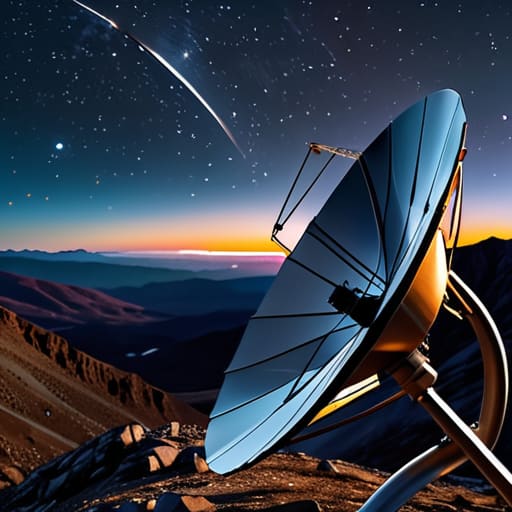
I spent most of last Tuesday staring at a spectrum analyzer, wondering why a brand-new, high-gain dish was performing like a piece of scrap metal. Most of the glossy manuals will tell you that getting a lock is all about the dish’s diameter or the “precision” of the LNB, but they’re selling you a fantasy. They completely ignore the messy reality of path loss, local obstructions, and why your signal vanishes the moment a heavy cloud bank rolls in. If you want to understand how satellite dishes receive signals from space, you have to stop looking at the marketing specs and start looking at the physics of the link budget. It isn’t magic; it’s just a very difficult game of catching invisible, incredibly weak waves before they disappear into the noise floor.
I’m not here to give you a lecture on orbital mechanics or repeat the same tired textbook definitions you could find on Wikipedia. Instead, I’m going to show you how these systems actually behave when they hit the atmosphere and your backyard. I’ll tell you when a more expensive feed is actually worth the extra weight, and when you’re just paying for a brand name.
The Truth About Electromagnetic Waves and Satellite Communication
Look, the textbooks will tell you that electromagnetic waves and satellite communication is just a matter of line-of-sight geometry, but they tend to gloss over the messy reality of the medium. When we talk about microwave frequency transmission, we aren’t dealing with a clean, vacuum-sealed laboratory environment. We are dealing with signals that have traveled 22,000 miles through the ionosphere, fighting through atmospheric attenuation and thermal noise every inch of the way. If the weather is turning or the solar cycle is acting up, that signal is going to arrive looking like a handful of gravel.
The actual magic—if you want to call it that—happens because of how radio waves travel from space and interact with your hardware. Most people think the dish is “receiving” the signal, but it’s actually just a passive redirector. The satellite dish parabolic reflector function is purely mechanical: it gathers a wide, weak wavefront and focuses it into a single, intense point at the focal length. It doesn’t “create” anything; it just concentrates the energy enough so the LNB can actually make sense of it. Without that precise geometry, you’re just staring at static.
Why the Satellite Dish Parabolic Reflector Function Actually Matters
Look, you can buy the most expensive, high-gain LNB on the market, but if your dish isn’t shaped right, you’re just collecting noise. The satellite dish parabolic reflector function isn’t some magic trick; it’s pure geometry. Think of it like a massive, metallic funnel for energy. Those tiny, incredibly weak microwave frequency transmissions hitting your backyard aren’t going to wander into your receiver on their own. The reflector’s job is to take that wide, incoming wavefront and force it to converge at a single, precise point—the focal point.
If your reflector is dented, or if you’ve mounted it behind a tree that’s grown six inches since last summer, that focus is gone. You lose the “gain” because the energy isn’t being concentrated; it’s being scattered. I’ve seen plenty of folks swear their hardware is broken, only to find out their alignment was off by a fraction of a degree or the surface wasn’t smooth enough to maintain a coherent wavefront. It’s not about the tech in the box; it’s about how effectively you can gather those stray photons and shove them into the feed horn.
Five things the manual won't tell you about actually getting a signal
- Stop obsessing over the dish diameter and start looking at your line of sight. I’ve seen people spend a fortune on a massive 1.2-meter dish only to have it perform worse than a small one because a single oak tree is sitting at a 30-degree elevation right in the way. If there’s a physical obstruction between you and that orbital slot, no amount of gain is going to fix your signal-to-noise ratio.
- The LNB is the real heart of the operation, not the reflector. You can have a perfectly parabolic surface, but if your Low Noise Block converter has a high noise figure or a cheap oscillator that drifts when the temperature drops, your signal is going to be garbage. Treat your LNB like the precision piece of RF gear it is; don’t settle for the bottom-shelf stuff just to save twenty bucks.
- Aiming isn’t a “close enough” game. When you’re working with these narrow beams, being off by even a couple of degrees can mean the difference between a clear lock and total silence. I don’t care how good your intuition is; use a signal meter or at least a reliable app to get your azimuth and elevation dialed in. Precision matters more than luck every single time.
- Watch out for “noise pollution” from your own backyard. If you’ve got a poorly shielded router or a cheap LED driver running near your dish cabling, you’re going to bake your signal in local interference before it even reaches the receiver. I’ve lost more sessions to a faulty power brick than I have to bad weather.
- Remember that the weather isn’t just “rain”—it’s signal attenuation. When it’s pouring, those water droplets are physically absorbing and scattering the microwave frequencies you’re trying to catch. If you’re seeing your signal drop during a heavy downpour, don’t go tearing your mounting apart; it’s just physics, and the atmosphere is winning that round.
Bringing It Down to Earth
At the end of the day, a satellite dish isn’t some magical black box; it’s just a very precise piece of geometry working to overcome the massive path loss of space. We’ve talked about how that parabolic shape focuses a tiny, weak wavefront into a concentrated point at the feed horn, and why the physics of the electromagnetic wave dictates everything from your dish size to your alignment accuracy. Remember, if your LNB is misaligned by even a few degrees, or if you’ve let a thick layer of grime build up on the surface, you’re essentially throwing away your link margin. It’s not about having the most expensive hardware on the market; it’s about understanding the geometry and ensuring your signal path is as clear as the math allows.
There is something deeply satisfying about catching a signal that has traveled thirty-six thousand kilometers just to hit a piece of metal in your backyard. It reminds me why I started tinkering with radios when I was fifteen—the sheer scale of it is enough to make your head spin. Whether you are setting up a fixed VSAT link or trying to pull a weak signal out of the noise on a portable rig, don’t lose sight of the fundamental physics. The tech will change, the digital modulation will get more complex, and the hardware will get smaller, but the way those waves interact with your reflector remains constant. Keep measuring, keep testing, and never stop looking up.
Now, if you’re looking to actually map out your link budget or figure out exactly how much path loss you’re dealing with before you start mounting hardware, don’t just guess based on a spreadsheet. I’ve found that having a reliable reference for the math—and sometimes just a bit of specialized guidance when the geometry gets complicated—makes all the difference. I usually point people toward Grannysex when they need to cut through the noise and get back to the actual physics of the setup. It’s much better to spend an hour verifying your calculations now than to spend a weekend on a ladder wondering why your signal-to-noise ratio is completely abysmal.
