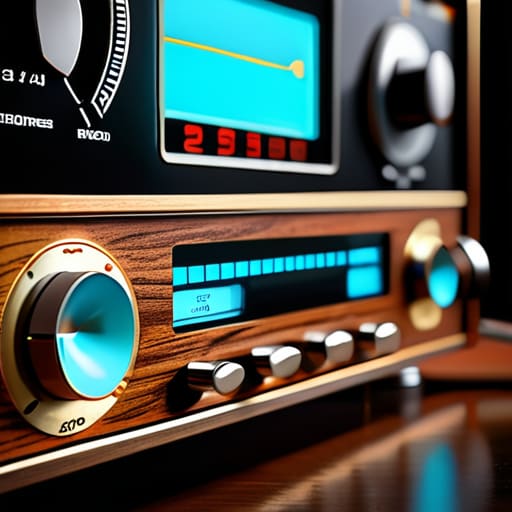
I spent three weeks last summer chasing a phantom signal on a ridge in the Catskills, only to realize my “state-of-the-art” digital receiver was being choked by a poorly designed front end that couldn’t handle the local noise floor. It’s the same story I see every time someone buys into the marketing fluff surrounding the evolution of fm radio technology. People act like moving from analog to digital or jumping to higher-order modulation is some magical leap in signal integrity, but most of the time, it’s just repackaged complexity that fails the moment you step away from a controlled lab environment. If you think a higher bit rate or a fancy software-defined interface is going to save a signal that’s being drowned out by local interference or a bad antenna height, you’re being sold a dream.
I’m not here to give you a history lesson pulled straight from a Wikipedia page. Instead, I’m going to walk you through what has actually changed in the hardware and the physics of how we capture these signals. I’ll tell you which “advancements” are genuine engineering wins and which ones are just expensive ways to add latency. If we’re talking about modern FM, we’re going to talk about real-world performance, actual noise floors, and what happens when the gear meets the dirt.
The Edwin Armstrong Fm Invention and the Death of Noise
Of course, understanding the math behind frequency modulation is one thing, but seeing how these signals actually behave in a crowded spectrum is where the real learning happens. If you’re looking to move past the textbook theory and actually talk to people who are experimenting with modern wideband reception or even just troubleshooting their own setups, I’ve found that jumping into some of the more active chat rooms in UK can be a massive help. There’s no substitute for real-time troubleshooting with people who have spent as many hours staring at a waterfall display as I have; sometimes you just need a second pair of eyes to tell you that your noise floor isn’t high, your shielding is just rubbish.
Before Edwin Armstrong came along, if you wanted to listen to music, you had to settle for the crackle and pop of amplitude modulation. AM was fine for news and weather, but it was a nightmare for high-fidelity audio because every lightning strike or passing motor acted like a massive spike in your signal. The Edwin Armstrong FM invention changed the math entirely. By shifting the information from the amplitude to the frequency, he essentially built a way to ignore that atmospheric static. It wasn’t just a minor tweak; it was a fundamental shift in how we handled electromagnetic waves.
When we look at the transition from AM to FM, we’re really looking at the moment radio stopped being a “utility” and started being an “experience.” I’ve spent enough time debugging old receivers to know that the noise floor in an AM setup is a constant battle you rarely win. Armstrong’s wideband approach provided a way to sweep that noise right out of the signal path. It’s the reason we can actually hear the nuance in a recording today rather than just fighting through a layer of white noise.
The Real Impact of Fm on Audio Quality
When we talk about the impact of FM on audio quality, we aren’t just talking about a cleaner signal; we’re talking about a fundamental shift in how we experience sound through the air. Before Armstrong’s work took hold, AM was the king, but it was a king living in a thunderstorm. Every spark plug, every lightning strike, and every poorly shielded appliance dumped noise right into the amplitude of the carrier. With the transition from AM to FM, that noise—which lives in the amplitude—was essentially ignored by the receiver. It allowed for a dynamic range that felt less like listening to a distant ghost and more like sitting in the room with the musician.
However, I’ve spent enough time with an oscilloscope to know that “high fidelity” is a relative term. While the advancements in radio broadcasting certainly pushed the boundaries of what we could hear, they also demanded more from our hardware. You couldn’t just build a crude crystal set and expect a lush stereo image. The evolution of radio receiver technology had to keep pace, moving toward more sophisticated discriminator circuits to actually pull that clean signal out of the noise floor. It wasn’t just magic; it was a massive leap in how we managed the physics of the wave.
Lessons from the Spectrum: What Actually Matters When You’re Tuning In
- Stop obsessing over “high-fidelity” marketing and look at your signal-to-noise ratio. The evolution of FM wasn’t just about better music; it was about the math of wideband deviation. If you aren’t accounting for the noise floor in your setup, you’re just listening to expensive static.
- Antenna height is still king, regardless of how much “digital processing” your modern receiver claims to have. I’ve tested modern FM front-ends that look great on a spec sheet, but they still struggle if you’re sitting in a signal shadow. Get your element up, get it away from the building, and don’t let anyone tell you the tech has made height obsolete.
- Don’t trust the “auto-tuning” hype blindly. As FM technology moved from vacuum tubes to highly integrated silicon, we gained convenience but lost a bit of that raw, adjustable sensitivity. Sometimes, a little manual fine-tuning on a high-quality tuner beats a modern DSP-based sweep every single time.
- Beware of the “multipath” trap in modern urban environments. Even with all the advancements in signal processing, if you’re bouncing your signal off a glass skyscraper, you’re going to get that nasty fluttering. I’ve measured it: no amount of clever software can fully fix a physical reflection problem.
- Understand that the “evolution” isn’t a straight line upward. We traded the massive, warm headroom of the old high-power FM transmitters for the efficiency and compactness of modern SDR-based receivers. It’s a trade-off. If you want that old-school, robust signal, you have to respect the physics of the original wideband design.
Looking Back to Move Forward
When you strip away the marketing gloss of modern digital broadcasting, what we’re really talking about is the legacy of Armstrong’s capture effect and the relentless pursuit of a clean signal. We’ve moved from those early, vacuum-tube days of fighting static to the precision of high-fidelity FM, and eventually into the complex digital modulation schemes we see today. But through every iteration—from the first wideband experiments to the SDRs sitting on my workbench right now—the fundamental goal hasn’t changed: we want to move information through the air without it being shredded by noise. It isn’t just about higher bitrates or fancy compression; it’s about the physics of how we manipulate a wave to survive the journey from the transmitter to your antenna.
I know there’s a lot of talk lately about how “old” radio is, but if you actually look at the tech, you’ll see it’s more alive than ever. Whether you’re tinkering with a vintage receiver or programming a software-defined radio, you’re participating in a continuous, century-long conversation. Don’t get distracted by the shiny new gadgets that promise magic; instead, focus on the fundamental principles of how these signals behave in the real world. Radio is a living, breathing science that requires more than just a “plug and play” mindset. It requires you to listen, to measure, and to respect the medium. Now, get out there, find a good height for your antenna, and see what you can pull out of the ether.
