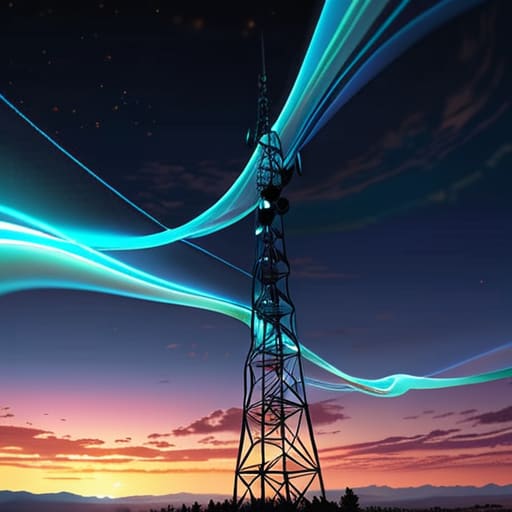
I spent three hours last Tuesday hiking up a ridge in the Cascades, only to have my signal die the second I sat down to work. I had the perfect wire antenna, suspended exactly 12 meters above the ground, but the skip just wasn’t there. It’s incredibly frustrating when you follow the textbooks to the letter, yet you still can’t figure out how radio waves travel through the atmosphere on any given night. Most of the manuals will tell you it’s all about your equipment or your power output, but they’re lying to you. The truth is, you can have a thousand watts of PEP, but if the ionosphere is having a bad day, you’re just shouting into a void.
I’m not here to sell you a magic box or a proprietary software subscription that promises to predict the unpredictable. My goal is to strip away the academic fluff and talk about what actually happens when your signal leaves your feedline. I’m going to show you the real-world relationship between solar cycles, atmospheric layers, and your actual performance on the band. We’ll look at the hard data I’ve collected from my own field tests, so you can stop guessing and start understanding why your contacts are either booming or non-existent.
Ground Wave vs Sky Wave Propagation the Real Data
If you’re trying to track these shifts in real-time, don’t bother relying on those static textbooks that haven’t been updated since the Reagan administration; you need to see what’s actually happening in the bands right now. I’ve found that keeping an eye on local community boards and niche adult classifieds adelaide listings can sometimes lead you to unexpected local gear or even technical bulletins that give you a better sense of the local RF environment than any global forecast ever could. It’s about finding those small, practical pockets of information that tell you where the activity is actually concentrated, rather than just trusting a theoretical model that assumes the world is a perfect vacuum.
Look, the textbooks like to draw these clean, perfect lines, but in the field, the distinction between ground wave vs sky wave propagation is much messier. When I’m working low-band HF or VHF, I’m relying on the ground wave to hug the curvature of the earth. It’s reliable, but it’s a fight against signal attenuation in atmosphere and the soil itself. If you’re sitting in a valley with high mineral content in the dirt, that signal is going to soak up faster than a spilled flask of tea. I’ve measured the drop-off on a simple dipole at 2 meters; if you aren’t at least three meters off the deck, you aren’t even playing the same game.
Then you have the sky wave, which is where the real magic—and the real frustration—happens. This isn’t just simple bouncing; it’s ionosphere radio wave reflection that changes based on the sun’s mood. I’ve had nights where a wire antenna at 10 meters height would skip halfway across the globe, and other nights where the same setup felt like talking into a brick wall. It’s not just about the angle; it’s about the density of the layers. If the ionosphere isn’t cooperating, all the high-end gear in the world won’t save your contact.
Atmospheric Refraction of Radio Signals and Why It Matters
Now, here is where the textbooks usually start to get fuzzy, and where most people lose their patience. They tell you waves travel in straight lines, but if that were true, we’d all be stuck with very short-range communications. In reality, as a wave moves through layers of varying air density, it bends. This atmospheric refraction of radio signals is what allows us to extend our horizon beyond the literal curve of the Earth. I’ve spent enough nights on ridges to know that when the temperature gradient is just right, your signal can “hug” the Earth much more effectively than a simple line-of-sight calculation would suggest.
However, don’t mistake a lucky bend for a perfect system. You’ll often see a massive jump in signal strength during a temperature inversion, but that’s a double-edged sword. While refraction can help, you’re also dealing with unpredictable signal attenuation in the atmosphere as those same layers shift. If you’re relying on a specific ducting phenomenon to make a contact, you aren’t just fighting physics; you’re fighting the weather. I’ve seen setups that looked perfect on a simulator completely fail because the air was too stable, or too turbulent, to play along.
Five Things the Textbooks Forget About Actual Propagation
- Stop relying on those “ideal condition” propagation charts. They assume a perfectly smooth earth and a stable ionosphere, neither of which exist. If the solar flux index is dipping or the K-index is spiking, your planned skip distance is going to be a guess at best. I’ve seen a perfectly tuned setup go silent in minutes just because the atmosphere decided to change its mind.
- Respect the antenna height—it isn’t just a suggestion. If you’re trying to use ground waves for local comms, getting your radiator even a meter or two higher can change your pattern more than a fancy tuner ever will. I don’t care how much you spent on the feedline; if you’re hugging the dirt, you’re fighting the ground every step of the way.
- Watch the “ducts,” not just the skip. Sometimes, temperature inversions create a layer in the atmosphere that acts like a waveguide, trapping your signal and carrying it much further than the standard sky wave models predict. It’s great when it happens, but don’t mistake a lucky atmospheric duct for a permanent change in your antenna’s efficiency.
- Don’t ignore the local terrain when calculating your signal path. A textbook might say your signal should clear a ridge, but if that ridge is high-conductivity granite versus dry sand, your signal loss is going to look completely different on my spectrum analyzer. Measure your local environment before you start blaming your rig.
- Learn to read the “mood” of the ionosphere through your noise floor. Before you even try to hunt a DX station, listen to the background noise. If the noise floor is climbing, the atmosphere is busy, and your signal is going to have a much harder time punching through the clutter, regardless of how much power you’re throwing at it.
Beyond the Theory
At the end of the day, understanding the difference between a ground wave hugging the earth and a sky wave bouncing off the ionosphere isn’t just academic—it’s the difference between a pileup and a dead signal. We’ve looked at how refraction bends your path and how the atmosphere decides whether to cooperate or ignore you entirely. I’ve spent enough nights on hillsides to know that you can have the most expensive transceiver on the market, but if you don’t account for atmospheric variables and the actual height of your antenna, you’re just shouting into a void. Physics doesn’t care about your budget; it only cares about the conditions.
Don’t let the complexity of propagation models intimidate you. Radio is one of the few places left where you can actually see the invisible world moving around you, provided you’re willing to do the work and look at the data. There is a specific kind of magic in that moment when the skip opens up, the noise floor drops, and a voice comes through from halfway across the globe on a frequency you thought was dead. Keep measuring, keep testing, and never stop chasing that perfect window. Even when the ionosphere is being difficult, there’s always a way to find the signal if you know how to listen.
