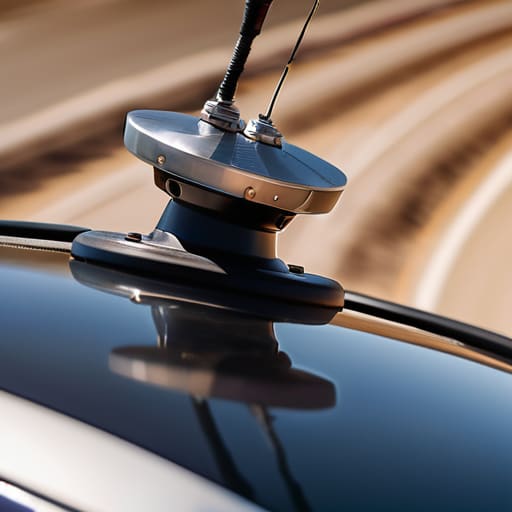
I spent three hours last Tuesday squinting at an SWR meter in a gravel parking lot, wondering why my signal was hitting the dirt instead of the horizon. I had just bought one of those “high-gain” miracle whips that promised to turn my compact hatchback into a long-distance powerhouse, only to realize I was fighting physics. People love to throw around technical jargon to sell you a piece of hardware, but when you’re asking what is a magnetic mount antenna actually capable of, the answer isn’t in the glossy brochure—it’s in the ground plane. If you don’t understand how that magnet is interacting with the metal beneath it, you aren’t building a radio station; you’re just mounting a very expensive piece of scrap metal to your roof.
I’m not here to sell you on the hype or tell you that a cheap magnet will make you a DX king. In this post, I’m going to strip away the marketing nonsense and give you the real-world mechanics of how these things function. I’ll tell you exactly which vehicle surfaces act like a proper radiator and which ones will just swallow your signal whole. We’re going to talk about height, conductivity, and why your results might change depending on whether you’re parked on a steel deck or a fiberglass sunroof. No fluff—just the measured truth.
Table of Contents
Magnetic Base Antenna Performance Measuring the Actual Gain

When people ask me about magnetic base antenna performance, they’re usually looking for a number on a spec sheet. But spec sheets are lies if they don’t account for the metal underneath. I’ve spent enough afternoons with a field strength meter to know that your “gain” is almost entirely dependent on the car you’re sitting in. A magnetic mount isn’t just sitting on a surface; it is trying to turn that entire roof into a radiator. This is where the antenna ground plane importance comes in. If you’re mounting on a small sedan with a limited surface area, you’re going to see a massive drop in signal compared to a long-roof station wagon or a truck.
I ran a side-by-side test last month comparing a standard CB radio mag mount vs permanent mount setups on a mid-sized SUV. The permanent mount, being bolted directly to a structural ground, gave me a consistent 2dB advantage across the band. The mag mount was erratic; its performance fluctuated based on how much of the roof was actually steel versus fiberglass or sunroof glass. If you want to maximize your magnetic antenna signal strength, you have to treat the vehicle surface as part of the antenna itself.
The Truth About Antenna Ground Plane Importance

Here is the reality: a magnetic mount isn’t just a piece of hardware; it is half of a system. When you slap that base onto a car roof, you aren’t just attaching an antenna—you are turning the entire metal skin of your vehicle into the other half of the antenna. This is where antenna ground plane importance becomes a non-negotiable factor. Without a sufficient area of conductive metal underneath that magnet, your SWR is going to climb faster than a summer sun, and your radiation pattern will look like a squashed mess instead of the efficient donut shape we’re looking for.
I’ve spent too many afternoons testing these on different rigs, and the difference is stark. If you’re comparing a CB radio mag mount vs permanent mount, remember that a permanent mount usually has a dedicated counterpoise or a more stable connection to the chassis. A magnetic base is at the mercy of the surface it sits on. If you’re mounting on a thin aluminum panel or a composite roof that’s mostly plastic, you’re essentially asking the antenna to scream into a pillow. You need that metal mass to reflect the signal outward, rather than letting it bleed into the car’s electronics.
Five Ways to Stop Chasing Phantom Signal Strength
- Stop assuming your car is a perfect ground plane. If you’re mounting on a fiberglass roof or a plastic hatch, that magnetic base is basically floating in a vacuum, and your SWR is going to climb like a fever. You need metal underneath it to actually make the physics work.
- Watch your cable routing. I’ve seen too many people run a coax line right along the edge of a door seal or through a tight corner where the dielectric gets crushed. If you pinch that cable, you aren’t just losing signal; you’re creating a localized impedance mismatch that’ll make your tuner work harder than it needs to.
- Don’t trust the “high gain” marketing on the box. A magnetic mount is physically limited by its height above the vehicle. If a manufacturer claims a massive gain increase on a tiny whip, they’re likely just playing with the radiation pattern. Measure your actual field strength; don’t just take their word for it.
- Check your magnet’s seat every few months. Vibration from driving—especially on those washboard backroads I love—can cause the base to micro-shift. If it’s not seated perfectly flat against the metal, you lose your ground connection, and suddenly you’re back to square one with a noisy, inefficient radiator.
- Remember that height is everything. A magnetic mount gets you an antenna on a car, but it doesn’t magically turn a sedan into a high-altitude tower. If you’re trying to work DX on 20 meters, don’t be surprised if you’re mostly just talking to the guy three towns over; you’re still fighting the physics of being low to the ground.
The Bottom Line: When to Use a Mag Mount
A magnetic mount is a compromise, not a miracle; it’s a tool for convenience and portability, but you are trading off the efficiency and radiation pattern of a fixed, permanent installation.
The metal surface you stick it to is part of the antenna system; if you’re mounting it on a small trunk lid or a thin hatch, you’re essentially starving the antenna of the ground plane it needs to actually work.
Don’t blame your rig or the ionosphere for a poor signal if your mounting surface is too small; if you can’t provide a decent radial footprint, you’re just wasting power.
The Ground Plane Reality Check
“A magnetic mount isn’t a magic wand; it’s just a compromise. You’re essentially trying to turn the sheet metal of your car into a makeshift ground plane, and if that metal is thin, rusted, or shaped like a crumpled soda can, your SWR is going to tell you the truth long before the ionosphere does.”
Wren Castellano
The Bottom Line on Magnets and Metal
At the end of the day, a magnetic mount is a compromise, not a miracle. You’ve seen the data: if you’re mounting on a small car roof or a thin metal hatch, you aren’t getting the full benefit of that ground plane, and your SWR is going to dance around more than you’d like. It works because it’s convenient, but it only performs when you respect the physics of the counterpoise. Don’t fall for the marketing claims of “high gain” if the base is only two inches wide; you need a solid connection to a substantial piece of metal to actually push your signal out of the local noise floor.
I know there’s a temptation to just buy the flashiest rig and expect the airwaves to open up, but radio is about understanding the link between your hardware and the environment. Whether you’re setting up a quick mobile station for a weekend trip or trying to squeeze a signal out of a commuter car, remember that measurement beats hearsay every single time. Go out there, test your connections, and don’t be afraid to move that mount a few inches to see how the pattern shifts. That’s where the real learning happens—not in the manual, but in the actual signal strength you see on the waterfall.
Frequently Asked Questions
If I’m mounting this on a fiberglass roof or a plastic canopy, how much am I actually going to lose in signal compared to a steel roof?
You’re going to take a hit, and not just a little one. A steel roof acts as a massive, ready-made ground plane; it’s part of the antenna system. When you move to fiberglass or a plastic canopy, you’ve effectively stripped the antenna of its partner. Without that conductive surface, your SWR will likely spike, and your radiation pattern will collapse toward the horizon. Unless you’ve got a dedicated counterpoise wire running somewhere, expect significantly less gain.
Can I use a magnetic mount for HF bands, or am I strictly limited to VHF/UHF because of the ground plane requirements?
Technically, you can, but you’re fighting an uphill battle. Most magnetic mounts are designed for VHF/UHF because those wavelengths are short enough to play nice with a small metal roof. If you try to run HF, you’ll find the radiation pattern is a mess and your SWR will be dancing. Unless you have a massive, continuous steel surface acting as a counterpoise, you’re mostly just heating up your car’s roof instead of the ionosphere.
Is there any point in buying a high-end coax if the magnetic base itself is the bottleneck for my SWR?
Look, I’ve seen it a dozen times: someone drops a fortune on a high-grade, low-loss coax only to plug it into a magnetic base that’s struggling to find a decent ground plane. If your SWR is swinging wildly because the base can’t find a stable match against your car’s roof, that expensive cable isn’t going to save you. Fix the bottleneck first. Buy the decent, mid-range coax once you’ve actually stabilized your antenna’s impedance.
