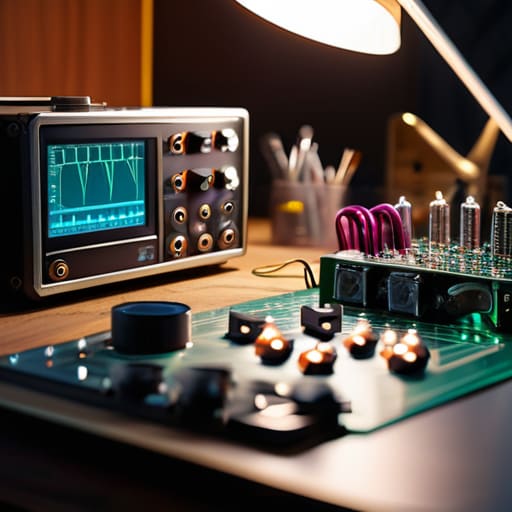
I remember sitting in my first professional lab back in the late nineties, surrounded by expensive shielding and “certified” components, only to realize my entire test setup was being trashed by a cheap switching power supply sitting three feet away. People love to treat Electromagnetic Compatibility like some mystical, high-level physics concept that requires a PhD to grasp, but when you’re staring at a spectrum analyzer and seeing nothing but a wall of noise, the academic definitions don’t help. If you’re sitting there wondering what is emc in a way that actually matters to your station, stop looking at the textbook diagrams. It isn’t just a compliance checkbox for manufacturers; it is the brutal reality of how your gear survives—or fails—in a world that is increasingly loud and electrically crowded.
I’m not here to give you a lecture on Maxwell’s equations or sell you a $5,000 specialized enclosure. My goal is to show you how to identify the noise, find the source, and actually fix the problem using the tools you already have on your bench. I’ll tell you what works, what’s a waste of your money, and when your “clean” signal is actually just a lucky break with the local interference cycle.
Table of Contents
- Emi vs Emc Explained Separating Signal From Chaos
- Regulatory Compliance for Electronics More Than Just Paperwork
- Stop Guessing and Start Measuring: My Five Rules for Living with Noise
- The Bottom Line: Stop Guessing, Start Measuring
- The Reality of the Noise Floor
- Bottom Line: Stop Guessing, Start Measuring
- Frequently Asked Questions
Emi vs Emc Explained Separating Signal From Chaos
People often use these terms interchangeably, but if you’re trying to troubleshoot a noisy station, that mistake will cost you hours of frustration. Think of EMI (Electromagnetic Interference) as the actual “bad actor”—the unwanted signal, the spark from a brushed motor, or that cheap LED driver in your living room that’s dumping noise across the HF spectrum. It is the source of the chaos. EMI is the intruder breaking into your quiet frequency.
EMC, on the other hand, is the state of being. It’s the equilibrium. When we talk about emi vs emc explained in a practical sense, EMC is the measure of how well your gear plays with others. It’s the ability of your radio to function in its intended environment without being wrecked by outside noise, and without becoming a source of noise itself. Achieving this isn’t just about passing some arbitrary regulatory compliance for electronics; it’s about ensuring your receiver isn’t just a glorified noise detector. If your shielding is poor or your grounding is an afterthought, you aren’t practicing radio; you’re just listening to the local power grid.
Regulatory Compliance for Electronics More Than Just Paperwork
Look, I know the feeling. You’ve spent six months prototyping a new SDR frontend, and then you hit the wall of regulatory compliance for electronics. It feels like a bureaucratic scavenger hunt designed to slow you down. But here’s the reality from someone who has sat in those testing labs: compliance isn’t just about checking boxes so a government agency doesn’t fine you; it’s about ensuring your device doesn’t become a rogue agent in the spectrum. If your gear fails electromagnetic susceptibility testing, it’s not just a paperwork failure—it means your device is a sitting duck for every nearby switching power supply and cell phone.
The industry standard for emc compliance requirements can feel arbitrary, but there is a method to the madness. Whether you are looking at FCC Part 15 or the CE markings, these rules exist because the spectrum is crowded. You can have the most elegant circuit design in the world, but if your shielding and grounding techniques are sloppy, you aren’t building a radio tool; you’re building a noise generator. I’ve seen plenty of “compliant” gear that only passed because the lab technician was having a particularly easy Tuesday. Don’t trust the sticker; trust your measurements.
Stop Guessing and Start Measuring: My Five Rules for Living with Noise
- Treat every cable like an antenna. If you leave a long run of unshielded coax or a messy bundle of DC power wires sitting near your receiver, you aren’t just connecting components; you’re building a localized broadcast station for every bit of RFI in your shack. Use shielded twisted pairs and keep your signal paths as short and tight as the physics allow.
- Grounding isn’t a suggestion; it’s your primary defense. I don’t care how many “grounding stickers” you see online—you need a low-impedance path to a real ground. A single-point ground is usually your best bet to prevent ground loops, which are nothing more than tiny, annoying transformers turning your chassis into a noise source.
- Ferrites are tools, not magic charms. I’ve seen people snap snap-on beads onto every inch of a rig thinking it’ll fix everything. It won’t. You need to identify the frequency of the interference first. If you’re fighting high-frequency switching noise from a cheap LED power supply, you need a specific core type, not just a handful of random black beads.
- Separation is free, and it’s often more effective than any filter you can buy. If your switching power supply is sitting three inches from your sensitive SDR front-end, you’ve already lost the battle. Give your high-current lines and your high-sensitivity receivers some physical breathing room; distance is the most underrated component in an EMC strategy.
- Measure your noise floor before you blame the ionosphere. When a band goes quiet, don’t immediately assume the solar cycle is the culprit. Turn off your gear piece by piece, or better yet, use a spectrum analyzer to see if your own local electronics are just raising the floor. If you don’t know what your baseline looks like, you’re just chasing ghosts.
The Bottom Line: Stop Guessing, Start Measuring
EMC isn’t a theoretical concept for a lab manual; it’s the practical reality of ensuring your gear doesn’t turn into a noise source that kills your own reception or drives your neighbors’ electronics haywire.
Understanding the distinction between EMI (the actual noise being generated) and EMC (how well your system handles that noise) is the first step toward actually fixing a problem instead of just swapping parts.
Compliance isn’t just about passing a test to get a sticker on a box; it’s about building a stable, predictable system that works in the real world, not just on a clean workbench.
The Reality of the Noise Floor
EMC isn’t some abstract compliance checkbox to satisfy a regulator; it’s the practical struggle to keep your gear from becoming its own worst enemy. You can have the most expensive transceiver on the market, but if your power supply is leaking RF like a sieve or your shielding is a joke, you aren’t operating a radio—you’re just listening to a very expensive, very expensive-looking bucket of noise.
Wren Castellano
Bottom Line: Stop Guessing, Start Measuring
At the end of the day, understanding EMC means moving past the vague idea that “noise is just part of the job.” We’ve looked at how EMI is the actual culprit—the unwanted signal—and how EMC is the framework we use to keep our gear from turning into a glorified space heater that screams interference across every band. Whether you are navigating the headache of regulatory compliance or just trying to figure out why your SDR is seeing a massive spike every time your neighbor turns on a microwave, the principle remains the same: you cannot manage what you haven’t actually quantified. It isn’t about following a checklist to satisfy a certificate; it’s about ensuring your equipment behaves predictably in a crowded, noisy world.
I know it can feel overwhelming when you first start looking at shielding, grounding, and trace layouts, but don’t let the complexity drive you back to the textbooks. Radio is a physical, tactile medium, and EMC is just another variable to master, much like antenna height or solar cycles. Once you stop treating interference as a mystery and start treating it as a measurable engineering challenge, the whole hobby changes. You stop fighting your gear and start working with it. So, grab your spectrum analyzer, find where that noise floor is actually sitting, and start measuring. That’s how you move from being a user to being a real operator.
Frequently Asked Questions
If my home station is causing interference for my neighbors, am I actually violating FCC rules or just being a bad neighbor?
Technically, it’s both. The FCC rules aren’t just suggestions; they’re there to ensure the spectrum stays usable for everyone. If your station is leaking noise into the neighbor’s VHF or drowning out their digital services, you’re likely violating Part 15 or Part 97 regulations regarding harmful interference. But beyond the legalities, it’s about being a good operator. If I’m causing a ruckus, I don’t wait for a fine—I grab my spectrum analyzer and fix it.
Can I use ferrite beads and shielded cables to fix EMI issues, or is my entire rig's layout fundamentally flawed?
Look, ferrite beads and shielded cables are great tools, but they aren’t magic wands. If you’ve got a massive common-mode current loop because your power supply is sitting right next to your sensitive receiver input, a snap-on bead is just a band-aid on a broken leg. Use the shields to manage the noise you know is there, but if you’re chasing ghosts, stop adding components and start looking at your ground plane and component separation.
How much does the physical placement of my gear—and the height of my antenna—actually impact the electromagnetic noise floor in my shack?
It’s everything. You can buy the cleanest transceiver on the market, but if your rig is sitting right next to a switching power supply or a cheap LED driver, you’re just amplifying the mess. As for the antenna, height isn’t a suggestion; it’s the math. A dipole at 10 meters behaves entirely differently than one at 20 meters regarding ground losses and local noise pickup. If you don’t account for height, you aren’t measuring signal—you’re measuring your backyard.
