
I remember sitting in a drafty community center basement when I was fifteen, staring at a question about frequency allocation that felt more like a history quiz than an engineering test. Everyone tells you that you need to master every single line of the manual to pass, but let me tell you: that is a complete myth. Most people spend weeks memorizing dry, academic definitions only to realize that the actual exam is less about being a walking encyclopedia and more about whether you can apply basic logic to a radio circuit. If you’re currently staring at a stack of study guides wondering what is a licence exam like in the real world, stop worrying about the fluff and start focusing on how signals actually move.
I’m not here to give you the sanitized, “everything will be fine” version you’ll find in the official study pamphlets. I’m going to tell you exactly what to expect when you’re sitting in that chair, from the specific ways they try to trip you up on regulations to the actual technical concepts that matter once you’re out in the field. I’ll give you the unvarnished truth about the difficulty, the pacing, and the common pitfalls, so you can stop studying hard and start studying smart.
Table of Contents
Decoding the Professional Certification Exam Structure

When you sit down to look at the actual professional certification exam structure, don’t expect a single, monolithic wall of questions. Most jurisdictions break it down into specific modules—usually covering regulations, operating practices, and technical theory. It isn’t a marathon; it’s more like a series of short sprints. You’ll find that the questions are designed to be binary: you either know the frequency limits for a certain mode, or you don’t. There isn’t much room for “interpretation” once the clock starts ticking, which is a relief if you’re someone who tends to overthink the physics of a signal path.
The way they handle the scoring and results process is fairly straightforward, but it’s where the nerves usually kick in. You aren’t just aiming for a passing grade; you’re aiming for a threshold that proves you won’t accidentally interfere with a local repeater or, worse, a maritime distress call. I’ve seen plenty of bright engineers stumble here because they treated it like a theoretical math test rather than a practical safety check. Keep your eyes on the specific requirements for your desired class, because the depth of the technical section shifts significantly once you move past the fundamentals.
Standardized Testing Procedures vs Real Radio Skills

Here is the reality: passing a standardized testing procedure doesn’t mean you can troubleshoot a noisy power supply or find the null in a directional antenna. The exam is a gatekeeper designed to ensure you won’t accidentally interfere with a local hospital’s telemetry or a maritime distress frequency, which is vital. However, there is a massive gap between knowing the legal definition of “harmful interference” and actually identifying it on a waterfall display when your SWR is spiking for no apparent reason.
The testing process focuses on your ability to recall specific regulations and mathematical formulas, but it won’t measure your intuition. I’ve seen folks breeze through the scoring and results process with perfect marks, only to freeze up the moment they have to actually tune a wire antenna in the wind. Don’t mistake the certificate for the craft. The exam proves you have the baseline knowledge required to sit at the controls, but the real skill comes from the hours you spend failing, adjusting, and eventually hearing that first weak signal break through the noise.
Five Things the Study Guide Won't Tell You
- Don’t memorize the math at the expense of the concept. I’ve seen plenty of people breeze through the calculations for wavelength only to stare blankly when asked how a ground plane actually affects your SWR. The exam wants to see if you understand the relationship between the physical wire and the signal, not just if you can plug numbers into a formula.
- Expect a heavy emphasis on regulations that feel like they belong in a different era. You’ll spend a disproportionate amount of time on things like frequency allocations and station identification rules. It feels tedious, but in the real world, knowing exactly where your signal is allowed to live is the difference between being a hobbyist and being a nuisance to the authorities.
- The “trick” questions are usually about safety and interference. They aren’t trying to catch you out on complex RF theory; they are checking to see if you’re the kind of person who will accidentally cook your neighbor’s electronics or trip a breaker with a poorly tuned feedline. Treat the safety section as the most important part of the test, not just a hurdle to clear.
- Prepare for a disconnect between the textbook and the hardware. The exam might ask you about a theoretical component in a perfect vacuum, but when you get your hands on an actual transceiver, you’ll realize real-world noise floors and impedance mismatches are much more forgiving—or much more stubborn—than the multiple-choice options suggest.
- Learn to read the questions twice, especially the ones involving “except” or “not.” I’ve sat in rooms where I could hear the collective sigh of people who knew the material but fell into the trap of rushing. The exam tests your precision, and in radio, precision is what keeps your signal on the band and off the emergency frequencies.
The Real Bottom Line
Don’t mistake passing the test for being a radio operator; the exam proves you can follow rules and memorize definitions, but it doesn’t tell you how to troubleshoot a noisy power supply or why your SWR is spiking when the wind picks up.
Treat the technical questions as the “grammar” of the hobby—you need to know them to communicate legally and safely, but knowing the rules of grammar isn’t the same thing as being able to write a good story.
Focus on understanding the why behind the regulations and physics rather than just memorizing the multiple-choice answers, because the ionosphere doesn’t care how well you can bubble in a Scantron.
The Gap Between the Paper and the Airwaves
Passing the exam proves you can navigate a multiple-choice booklet without tripping over the terminology, but it doesn’t mean you’re ready to troubleshoot a high SWR reading in a rainstorm or realize your dipole is performing like a wet noodle because you hung it too close to a metal roof. The test measures your memory; the radio measures your reality.
Wren Castellano
Beyond the Question Paper
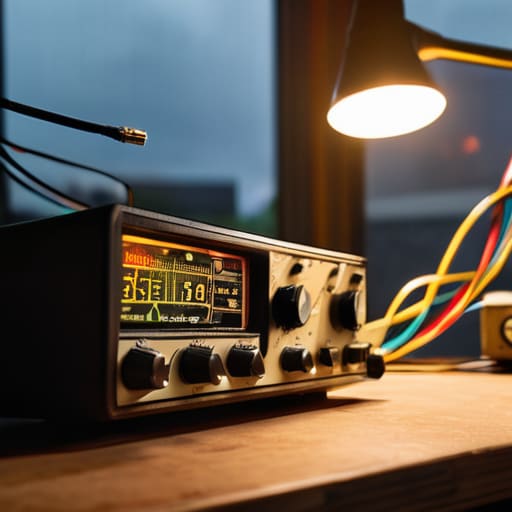
Look, if you’ve made it this far, you already know the truth: the exam is a gatekeeper, not a masterclass. It’s designed to ensure you won’t accidentally melt a neighbor’s receiver or interfere with emergency services, but it won’t teach you how to troubleshoot a high SWR caused by a damp coax in a sudden downpour. You’ll walk out of that room knowing the precise mathematical definitions of modulation and frequency deviation, but that is only the foundational layer. The real gap lies between passing a standardized test and understanding how a signal actually behaves when it hits the ground or bounces off a layer of the ionosphere that’s behaving badly. Don’t mistake the certificate for the craft; the exam is just the entry ticket to the real learning.
Once you have that piece of paper, the real work begins. My advice? Don’t stop being a student just because you passed. The most dangerous operator I ever met was the one who thought the license meant he had nothing left to learn. Radio is a living, breathing thing that changes with the sunspots, the seasons, and the gear you build with your own hands. Use the theory you learned to build something, break it, and then measure why it broke. That is where the magic happens. Get your license, get on the air, and then go out and find the signal.
Frequently Asked Questions
If I pass the exam, does that mean I actually know how to build a tuner or set up a wire antenna without blowing a transistor?
Short answer? No. Passing the exam means you’ve mastered the vocabulary and the regulatory boundaries, which is vital, but it doesn’t mean you’ve developed the “feel” for the gear. You can know the theory of impedance matching perfectly and still blow a final transistor because you didn’t notice your SWR spiking when you moved your antenna six inches closer to a metal fence. Real skill comes from the mistakes you make once you’re actually on the air.
How much of the technical math is actually used in a real field setup versus just being there to trip people up?
Look, if you’re worried about solving differential equations on a scratchpad, take a breath. You aren’t going to be calculating complex impedance by hand while standing in a muddy field in the rain. The math in the exam is mostly there to ensure you understand the relationship between variables—like how frequency affects wavelength. In the real world, I use a calculator or a software model. The exam tests your intuition; the field tests your ability to apply it.
Is there a way to study that focuses on how signals actually behave instead of just memorizing the specific wording of the regulations?
You want to understand the physics, not just the phrasing. My advice? Get a cheap SDR dongle and a wire antenna. Don’t just read about propagation; watch the waterfall display when the sun goes down or a storm rolls in. When you see how a signal actually shifts or fades in real-time, the regulatory rules about frequency spacing and power limits stop being arbitrary numbers to memorize and start being logical boundaries that make sense.
