
I’ve lost count of how many times I’ve sat in a club meeting and watched someone try to decide which wire to hang based on a colorful marketing brochure. They’ll talk about “gain enhancement” and “ultra-wideband efficiency” like those words actually mean something when you’re standing in a damp field at 2:00 AM. If you’re trying to figure out how to compare two antennas, stop looking at the glossy spec sheets and start looking at your actual environment. A theoretical gain figure is completely meaningless if you don’t account for the height above ground or the local clutter, and I’m tired of seeing people spend three hundred dollars on a “high-performance” radiator only to realize it performs worse than a piece of copper wire because they didn’t respect the physics of their setup.
In this post, I’m going to show you how I actually run these tests when I’m out in the field. We aren’t going to rely on mathematical models that assume a perfect vacuum; instead, I’ll walk you through using a real SWR meter, a field strength meter, and—most importantly—consistent variables. I’ll tell you exactly what I measure, what I ignore, and how to tell if a signal is actually better or if the ionosphere just decided to play nice for a few minutes.
Table of Contents
Beyond the Spec Sheet Real World Antenna Efficiency Metrics

If you’re looking at a manufacturer’s datasheet and seeing a massive number for gain, take a breath. Most of those figures are calculated in a vacuum, often using idealized models that don’t account for the messy reality of a backyard or a hilltop. When I’m looking at antenna efficiency metrics, I don’t care what the math says it should do; I care about what it actually does when I’m trying to pull a weak signal out of the noise. A high-gain Yagi is useless if its narrow beamwidth means you’re constantly fighting to keep it pointed at the right spot while the wind is gusting.
Instead of obsessing over theoretical peaks, I focus on signal-to-noise ratio testing during actual operating sessions. I’ll set up two different dipoles at the exact same height—let’s say 10 meters up a pine tree—and see which one actually delivers a cleaner signal during a typical DX window. You might find that a “less efficient” antenna actually performs better because its radiation pattern is more forgiving of the local terrain. Don’t let a low VSWR fool you into thinking you have a perfect system; a match is just a way to keep power from reflecting back to your rig, it isn’t a guarantee of a good signal out there.
The Truth About Vswr Comparison Methods and Impedance Matching
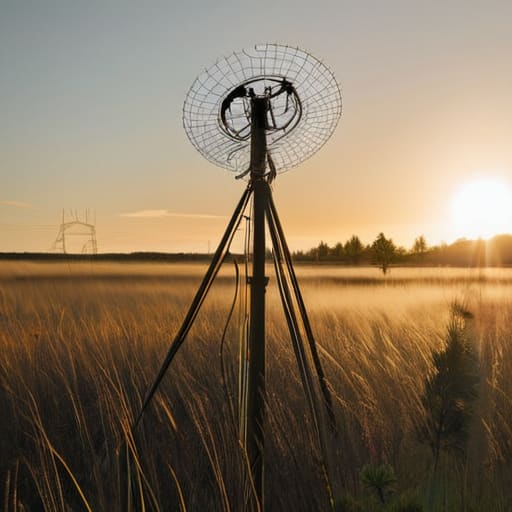
Here is the reality of the situation: a low VSWR is a vanity metric if you aren’t looking at the whole picture. I’ve seen plenty of rigs showing a perfect 1.1:1 ratio on a meter, only for the operator to wonder why they aren’t making any contacts. The problem is that VSWR only tells you how much power is being reflected back to the transceiver; it says absolutely nothing about how much of that power is actually being converted into a usable electromagnetic field. If your antenna impedance matching is technically “perfect” but your radiator is sitting three feet off the ground in a way that cancels out your signal, that low reading is just lying to you.
When you’re looking at different VSWR comparison methods, don’t just chase the lowest number. I always tell people to look at the bandwidth of that match. A narrow, deep dip in the SWR might look great on paper, but if it shifts five megahertz the moment a breeze hits your wire, it’s useless in the field. I’ve spent too many afternoons on a ridge realizing that a slightly higher, flatter SWR curve across the band is much more reliable than a “perfect” match that only exists in a vacuum.
Five Rules for Testing Without Losing Your Mind
- Stop comparing antennas in different environments. If you test one on a tripod in your backyard and the other draped over a pine tree, you aren’t measuring the antenna; you’re measuring the tree. Use the same mounting height and the same ground conditions for both, or the data is useless.
- Ignore the VSWR for a second and look at your actual signal-to-noise ratio. I’ve seen plenty of “perfect” 1.1:1 SWR antennas that perform like garbage because they have a terrible radiation pattern or they’re just picking up every bit of RFI from your neighbor’s LED lights.
- Measure the height, not just the length. An antenna’s performance changes drastically based on its clearance from the ground. If you’re comparing a dipole to a vertical, make sure you’re noting exactly how many meters above the deck they’re sitting, because that’s where the real magic—or the real failure—happens.
- Test during the same propagation window. You cannot compare a wire antenna’s performance on 20m on a Tuesday morning with another antenna’s performance on a Friday night when the ionosphere is wide open. Wait for a stable period, or better yet, keep your logs strictly to the same time of day.
- Use a real analyzer, not just a built-in SWR meter. Most rig-based meters are fine for checking if you’re about to blow a finals, but they won’t show you the impedance swings or the bandwidth limitations. If you want to know why one antenna “feels” better than the other, you need to see the actual Smith Chart.
The Bottom Line Before You Buy
Stop obsessing over VSWR alone; a low SWR doesn’t mean much if your antenna is a poor radiator, so focus on actual signal strength and radiation patterns in your specific environment.
Height is not a suggestion, it’s a variable—always measure your performance at the same height above ground, because an antenna that works on your desk will fail you once you hike it up a ridge.
Document your conditions, not just your results; if you had a great contact, check if the ionosphere was doing the heavy lifting or if your antenna design actually earned its keep.
The Fallacy of the Perfect SWR
Stop obsessing over a 1.1:1 VSWR on a spec sheet if you aren’t testing it at the same height and in the same environment where you actually plan to use it. I’ve seen “perfect” antennas go silent because they were mounted six inches off the deck, while a messy, mismatched wire hung twenty feet up the tree outperformed it every single time. An antenna isn’t a mathematical abstraction; it’s a physical object interacting with the ground and the sky, and if you don’t measure both, you aren’t measuring anything at all.
Wren Castellano
Stop Guessing and Start Measuring
At the end of the day, comparing antennas isn’t about finding the one with the prettiest marketing brochure; it’s about understanding how they behave when they’re actually in the air. We’ve talked about why a low VSWR can be a total lie if your radiation pattern is garbage, and why you can’t ignore the height above ground when you’re trying to gauge real efficiency. If you aren’t measuring the actual signal strength or observing how the antenna handles a change in local environment, you’re just playing with expensive wire. Don’t let a single number on a screen convince you that one design is objectively better than another—context is everything in RF.
My advice? Get out from behind the desk and take your gear into the field. The most important lessons won’t come from a simulator, but from that moment when you realize your “inferior” wire antenna is suddenly outperforming your high-gain beam because you finally found the right height. Radio is a physical, messy, and often unpredictable medium. Embrace that uncertainty, keep your measurements rigorous but realistic, and remember that the best antenna is ultimately the one that actually gets you on the air. Now, grab your analyzer and go see what the air is actually doing.
Frequently Asked Questions
If I'm testing these in my backyard, how much is the proximity of my neighbor's metal fence going to skew my comparative data?
It’s going to skew your data significantly. That fence isn’t just a neighborly boundary; it’s a parasitic element. If you’re testing a dipole and that metal is within a wavelength or two, it’s going to shift your resonant frequency and mess with your radiation pattern. You might think Antenna A is better, but if it’s just closer to the fence’s capacitive coupling, you’re measuring the fence, not the antenna. Move it, or at least account for it.
I've got a decent NanoVNA, but is it actually precise enough to tell the difference between two similar dipole designs, or am I just looking at noise?
The short answer is yes, but don’t mistake precision for accuracy. Your NanoVNA has more than enough resolution to distinguish between two dipole designs, provided your calibration is solid. If you aren’t calibrating at the exact point where your antenna meets the coax, you’re just measuring the cable. I’ve seen people chase 0.01 SWR differences that were actually just measurement artifacts. Calibrate often, keep your connections clean, and if the traces look identical, they probably are.
When you say "efficiency," are you talking about how much power is actually leaving the element, or just how well the antenna is tuned to my specific rig?
That’s a crucial distinction, and honestly, it’s where most people get tripped up. When I talk about efficiency, I’m not talking about your SWR. You can have a perfect 1:1 match that’s still incredibly inefficient because the energy is just turning into heat in the ground or the element itself. I’m talking about how much of that RF power actually makes it into the far field. A well-tuned antenna that’s too short is just a very efficient heater.
