
I spent most of last Tuesday on a ridge in the Blue Ridge Mountains, shivering slightly and wondering why I ever thought a three-hour hike was a good idea for a radio session. As I was untangling a mess of wire from a tree limb, I realized how much misinformation is out there regarding what is a random wire antenna. Most of the forums will tell you it’s some sort of “magic” solution for people who can’t be bothered to tune a dipole, or they’ll drown you in complex math that assumes you’re living in a vacuum. In reality, it’s just a piece of conductor that doesn’t follow a specific resonant length, and if you treat it like a black box of mystery, you’re going to have a very frustrating time when the SWR spikes.
I’m not here to sell you a proprietary matching network or recite a textbook that hasn’t been updated since the Reagan administration. My promise to you is simple: I’m going to tell you exactly how these things behave when they are hung at ten meters above ground and how much of your success depends on the tuner versus the actual physics of the wire. We’ll look at the real-world trade-offs, the gear that actually works, and when you should stop tinkering and just start listening.
Table of Contents
The Truth About Electrically Short Antenna Performance

Here is the reality that the textbooks usually gloss over: when you use an electrically short antenna, you aren’t just dealing with a lack of length; you’re dealing with a massive mismatch in physics. Because the wire is significantly shorter than a quarter-wavelength, its capacitive reactance goes through the roof. This is why people get frustrated when they see a massive SWR reading on their display. It’s not that the wire isn’t “working,” it’s that the energy has nowhere to go because the antenna hasn’t established a proper relationship with the ground.
This is where the antenna tuner necessity becomes non-negotiable. You can’t just plug a random length of copper into a transceiver and expect magic. You need a tuner to force that impedance into something your rig can actually handle, but—and this is the part I’ve learned the hard way—a tuner is not a substitute for a decent RF ground system. If you don’t provide a counterpoise or a solid ground, your tuner will spend all its time fighting the stray capacitance of your coax, and you’ll end up with more RF in your shack than out of your antenna.
Hf Radio Antenna Basics vs Real World Physics

Look, the textbooks will tell you that an antenna needs to be a resonant half-wave or a quarter-wave to work efficiently. That’s fine for a classroom, but in the real world, we often deal with lengths that don’t play by those rules. When you’re working with an electrically short antenna, you aren’t just fighting the physics of the wire; you’re fighting the physics of the space around it. A wire that’s too short for the band you’re targeting is going to have a very high capacitive reactance, and that’s where the math meets the mud.
This is why people get obsessed with impedance matching for random wire setups. You can’t just plug a mismatched length of copper into a transceiver and expect a miracle. You’re going to need an antenna tuner—and I mean a real, beefy one, not a cheap toy—to bridge that gap. But even with a tuner, don’t forget that your RF ground system is doing half the work. If you don’t have a decent counterpoise or a solid ground, that tuner is just going to be working overtime to compensate for a massive imbalance, and you’ll end up with RF in your shack instead of signal on the bands.
Five Things I’ve Learned the Hard Way (So You Don't Have To)
- Buy a decent wideband antenna tuner, not the cheapest one on the shelf. A random wire is essentially a giant, unpredictable impedance mess, and if your tuner doesn’t have enough range or enough torque to move those capacitors, you’re just going to be sitting there staring at a high SWR reading while the sun goes down.
- Height is your best friend and your biggest headache. I’ve seen a 50-foot random wire perform better than a 100-foot dipole just because the wire was hoisted 30 feet up a pine tree instead of being dragged through the scrub. If you can’t get it high, don’t bother calling it an antenna; call it a very expensive piece of copper string.
- Use a counterpoise or a good ground, or prepare to have your shack become part of the antenna. Without a stable reference point—whether that’s a radial system or even just a well-connected chassis—the RF is going to find its way back to your rig through the coax shield, and that’s a quick way to get a nasty RF burn or a fried transceiver.
- Don’t trust the “ideal” math in the manuals. A random wire’s resonant frequency is going to shift based on how close it is to a tree, how much moisture is in the air, and whether or not you’ve stepped on it. Measure your SWR in the actual spot where you intend to operate, not on your workbench in a controlled environment.
- Keep a real antenna analyzer in your kit. You cannot “feel” your way through a random wire setup. You need to see exactly where those high-impedance peaks are so you can decide whether to add more wire, shorten it, or just accept that the ionosphere is going to have to do the heavy lifting for you that night.
The Bottom Line: What to Actually Expect
Don’t expect a miracle; a random wire is a compromise, not a perfect resonant radiator, and it will almost certainly require a well-designed 9:1 unun to make the SWR manageable.
Height is non-negotiable; I’ve seen “perfect” random wire designs fail completely because they were strung at 5 meters, while a messy wire at 15 meters above ground will actually get you on the air.
Success is a moving target; you might have a solid signal on 40 meters one Tuesday, but if the ionosphere decides to shift or your ground plane is too poor, you’re going to have to accept that some bands just aren’t happening that day.
## The Myth of the "Magic" Wire
“People call it a ‘random wire’ like it’s some piece of chaotic magic that defies physics, but let’s be clear: it’s just an electrically short radiator that’s leaning heavily on your ground system to do the heavy lifting. It’ll get you on the air when you’re stuck in a park with nothing but a spool of copper and a dream, but if you aren’t willing to get it at least ten meters off the dirt, you aren’t building an antenna—you’re just building a very expensive heater.”
Wren Castellano
The Bottom Line on Random Wires
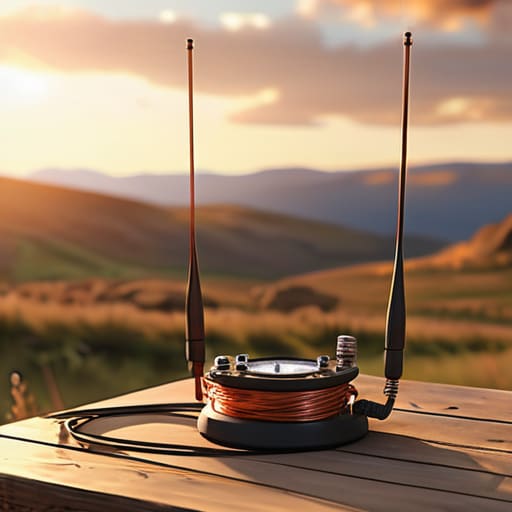
At the end of the day, a random wire antenna isn’t some mystical shortcut to DX; it is a tool that demands you respect the physics of impedance and ground loss. We’ve established that you can’t just throw a piece of copper in a bush and expect a miracle. If you want it to perform, you need a decent counterpoise, a solid tuner to handle the inevitable high SWR, and—most importantly—you need to get that wire at least 10 meters off the ground to keep your radiation resistance from bottoming out. It’s not about following a textbook formula from forty years ago; it’s about understanding that your antenna is only as good as the environment you place it in.
Don’t let the complexity of impedance matching scare you off. There is a unique, raw satisfaction in dragging a coil and a spool of wire up a ridge, setting up a station that shouldn’t work on paper, and suddenly hearing a station on the other side of the world through the static. Radio is at its best when it’s a bit messy and unrefined. Stop waiting for the “perfect” setup and just get something in the air. Once you start measuring your own results and seeing how the height and the ground actually change your signal, you’ll realize that the real magic isn’t in the gear—it’s in the connection.
Frequently Asked Questions
Do I really need a high-quality tuner, or will a cheap ninety-dollar box handle the impedance swings of a random wire?
Look, if you’re just playing in the backyard, that ninety-dollar box will get you on the air. But a random wire is a volatile beast. When the ground moisture changes or the wind shifts your wire, those impedance swings aren’t just small bumps; they’re jagged cliffs. A cheap tuner might struggle to find a match when the SWR hits 10:1, or worse, it’ll just give up. If you can afford the step up, do it.
How much of a difference does the ground plane actually make when I'm setting this up in a field versus my backyard?
In a backyard, you’ve usually got a nice, conductive layer of soil and maybe some lawn moisture helping you out. In a dry field, you’re often fighting much higher ground resistivity. If that field is parched or sandy, your “ground” is basically an insulator, and your radiation resistance is going to tank. I’ve seen a random wire go from a decent performer to a glorified heater just because the soil lost its moisture content.
Can I actually use a random wire for digital modes like FT8, or is the noise floor going to kill my signal?
You can, but don’t expect miracles. I ran a 30-foot random wire at 10 meters above a treeline last Tuesday; the FT8 decodes were solid, but only because the noise floor stayed low. If you’re running a short wire near a house full of switching power supplies, that noise floor is going to swallow your signal whole. It’s not the antenna’s fault—it’s the physics of being electrically short. Use a good tuner and watch your local RFI.
